

Employee Productivity Statistics: 2026 Benchmark Report

The modern state of workforce productivity presents a paradox: knowledge workers are working longer and harder than ever and using increasingly advanced tools, including AI, yet organizational output has stalled.
With constant interruptions to employee focus, context switching, and application overload, workforce productivity can no longer simply be measured by hours logged. Employers must move to measure true productivity and output based on results.
This article is a benchmark on the state of employee productivity and focus. By compiling the 25 most relevant workforce productivity statistics, we’ve painted a realistic picture of employee productivity in 2026. At Modge, our goal is to help employers understand the difference between true output vs vanity productivity metrics, and to help their employees achieve more.
Daily focus and interruptions
- Knowledge workers are hit with an average of 275 pings, emails, or meeting invites per day. This averages to one interruption every two minutes during core working hours. Employees can protect their focus by enforcing distraction-free “deep work” hours where messages and emails go silent. (Source)
- It takes an average of 23 minutes and 15 seconds to resume work after an interruption. While seemingly harmless, workplace interruptions cost more than people realize. With endless distractions, workers are taking much longer to get the bigger, higher-value projects done. (Source)
- 60% of interruptions are self-initiated. Well over half of interruptions are not someone else’s fault. Most distractions are self-initiated, such as checking social media, sports scores, or the news. These mini-distractions may seem like a harmless break, but many people take them too far, and it costs companies. (Source)
- Social media distraction alone costs the US economy $650 billion a year. Social media is the biggest culprit in workplace distraction. The cheap dopamine and endless scrolling entice workers to waste too much time at work, and it’s having an outsized negative impact on employers. (Source)
- Information retrieval is gobbling up 9 hours a week. Due to reliance on dozens of separate apps (also known as app fragmentation), knowledge workers spend 9 hours per week simply retrieving information. Eliminating data silos, consolidating and centralizing app usage, and finding and addressing bottlenecks in information retrieval are key to boosting productivity. (Source)
- Unproductive meetings consume 5 hours per week. Despite increased awareness of unproductive meetings, the time spent in them has doubled since 2019. 44% of workers dread their scheduled meetings. Creating a strong culture of “meetings only when necessary” and async communication goes a long way toward increasing productivity. (Source)
- Only 13% of knowledge workers still stick to a traditional 9-to-5 schedule. Expecting workers to commute to the office and focus uninterrupted for eight hours straight is no longer reasonable. Modern employers allow knowledge workers to clock in and out when they need to (and from where they need to) and recognize that the 9-to-5 was built for a different era and a different type of work. (Source)
Context switching, digital exhaustion, and productivity theater
- Knowledge workers spend 53% of their time on coordination and busywork. Only 47% of time remains for strategic execution. Workplaces that effectively streamline communication and collaboration can cut a big chunk out of the time workers spend on busywork. (Source)
- Knowledge workers switch tasks every 3 and a half minutes. Staying deeply focused on one task is a rarity in today’s knowledge workplace. Instead, workers are constantly getting distracted and switching between micro tasks throughout the day. (Source)
- Mental blocks from switching tasks can cost up to 40% of someone’s productive time. Frequent context switching has been found to significantly reduce productivity. Instead of focusing on one objective until completion, workers are getting pulled in different directions, which hurts their ability to get work done. (Source)
- 75% of desk workers report digital exhaustion. Application overload and constant digital connection are taking a toll. It’s one thing to be connected; it’s another to be distracted and exhausted. Organizations that protect employees' focus time also protect their energy and mental load. (Source)
- 65% of employees engage in “productivity theater” to appear busy. Many employees are paid to work 40+ hours per week but aren’t given 40+ hours of work to do. To ensure employees are engaged full-time, employers need to consider how much work to assign and whether it truly warrants a full-time commitment. (Source)
- Workers doing productivity theater are 13% more likely to experience burnout. It turns out that looking busy is even harder than actually being busy, and perhaps much worse for mental health. Employees would much rather be actually useful and productive than have to fake it for 40 hours a week. (Source)
- 68% of employees lack confidence that managers understand their workload. “Productivity theater” is a vicious cycle. A manager hires an employee who isn’t engaged and doesn’t give them enough work, but they don’t want to get fired, so they try to appear busy. Productivity theater thrives because managers either can’t tell the difference between fake and real work or just aren’t paying attention. (Source)

AI adoption and its impact on productivity
- 60% of desk workers use AI daily. That number increased a whopping 233% over six months in 2025, when workforce AI use caught fire. To ensure workers enjoy the productivity AI enables and remain skilled for the new era, employers must have a plan to promote and develop AI capabilities. (Source)
- Daily AI users are 64% more likely to report high productivity. That’s alongside 58% better focus and 81% more likely to report higher job satisfaction. AI is truly no longer a “nice to have” in the workplace, but a “must have” for a productive, modern workforce. (Source)
- 49% of Microsoft 365 AI prompts support cognitive analysis, reasoning, and decision-making. With Microsoft 365 mostly used as business software, it’s encouraging to see that nearly half of the prompts support productive work rather than trivial or personal questions. (Source)
- 66% of AI users report spending more time on high-value work. In addition, 58% produce deliverables considered impossible a year ago. While information-gathering busywork persists in the workplace, AI can cut into that workflow and unlock higher-value productivity gains. (Source)
- Tech-focused AI deployments are 1.6x more likely to miss ROI expectations versus human-centric workflow redesign. For AI to unlock productivity and deliver the ROI businesses expect, it needs to be tailored to real human workflows. That means people on the ground floor need to train the AI and identify where it’s most effective in their daily work. However, 59% of organizations are taking a more “tech-focused” approach. (Source)
- Organizational factors drive 2x the impact on AI productivity compared with individual effort alone. Organization-led factors, such as manager support and company culture, account for 2x the reported AI impact of individual efforts, such as mindset and behavior (67% vs. 32%). Getting the entire organization on board with AI and having managers support employees is how organizations unlock the most productivity from AI. (Source)
- 80% of leaders and employees worry colleagues use AI to fake productivity. With so many workers engaging in productivity theater, it’s not surprising that organizations worry AI is making “faking productivity” easier than ever. AI is just as good at helping streamline unproductive tasks as productive ones. (Source)
- Only 12% strongly agree that AI has transformed how work gets done in organizations that have implemented AI. Despite high individual productivity gains, most workers feel that organization-wide AI adoption is either lacking or not transforming how work gets done. In other words, AI helps individuals get more done faster, but organizations as a whole still do things the same way as before. (Source)
Employee engagement and stress
- Global employee engagement dropped to 20%, costing the global economy $10T annually. Employee engagement, which measures employees' psychological attachment to their work, has dropped to its lowest level since 2020. Lower engagement has been shown to lead to lower productivity and poorer profitability. This could be due to the prevalence of workplace distractions and productivity theater outlined above. (Source)
- Global manager engagement has dropped to 22%, down 9 points from 2022. Previously, it was assumed managers were more engaged than their employees, but the gap is closing. Employers should take steps to ensure both managers and their employees are fully engaged with their work. (Source)
- 54% of US workers report higher daily stress levels due to job insecurity. While new technologies like AI have boosted productivity, they are also making workers more stressed about their job security. This increases daily stress for over half of US workers, eating into the productivity gains AI provides. (Source)
A better way to measure employee productivity
True employee productivity isn’t measured by time trackers and keystrokes alone. Simple trackers that rely only on these metrics can’t measure distractions, focus time, or whether the apps and websites employees are logged into are actually productive.
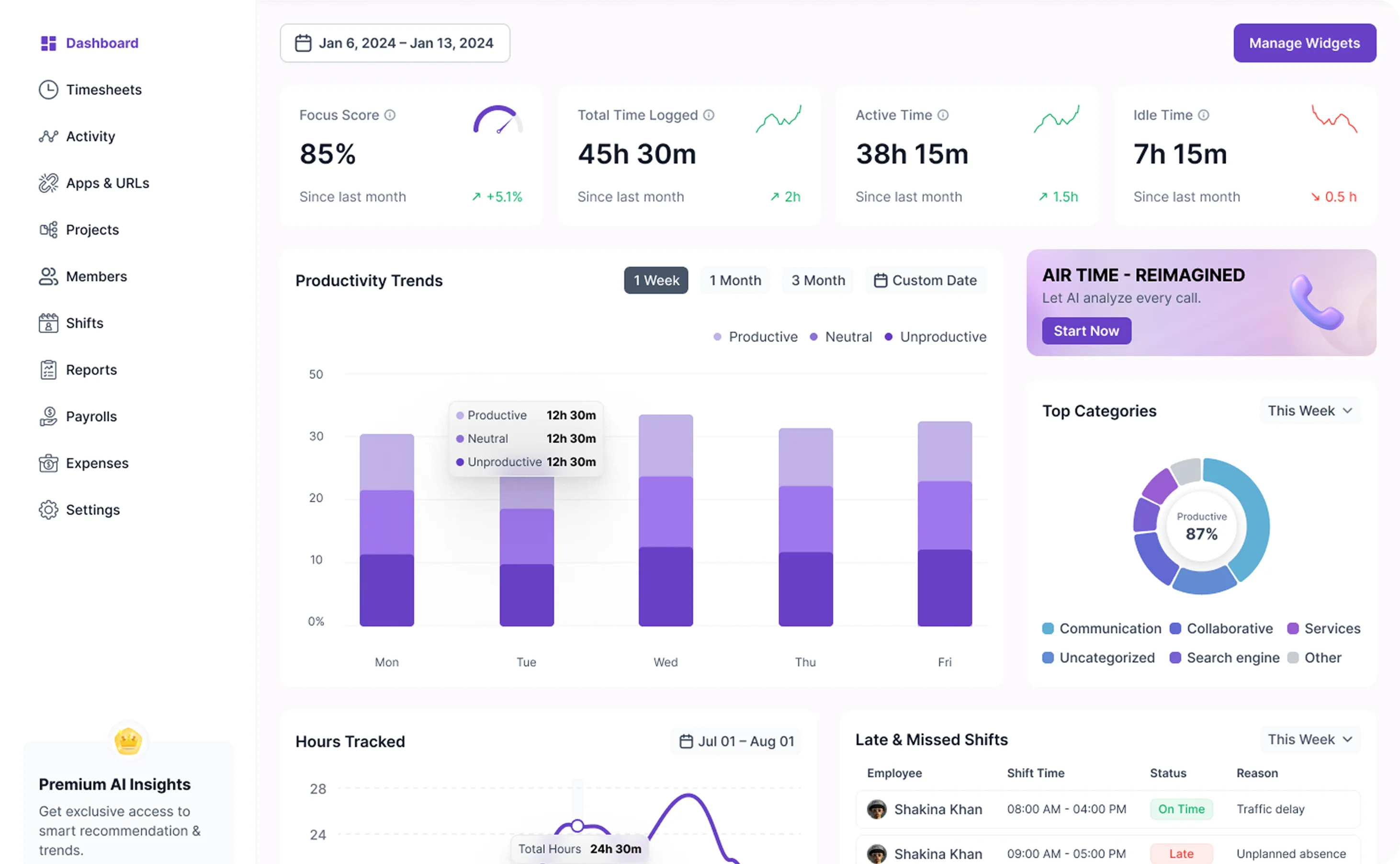
Employers need a deeper understanding of how their employees work. Modge provides that understanding with advanced features such as role-based app and website classification, focus block detection, and automatic time tracking that doesn’t require employees to “clock in” or manually edit timesheets.
Want to measure actual productivity instead of basic metrics that can easily be faked? Try Modge free for 14 days.
Table of contents


Ready to see Modge in action?
Start your free 14-day trial or book a personalized demo with our team today.
.svg)


